



Infants and Young Children
Everyone in a vehicle needs protection! This includes infants and all other children. Neither the distance traveled nor the age and size of the traveler changes the need, for everyone, to use safety restraints. In fact, the law in every state in the United States and in every Canadian province says children up to some age must be restrained while in a vehicle.
WARNING
Children can be seriously injured or strangled if a shoulder belt is wrapped
around their neck and the safety belt continues to tighten. Never leave
children unattended in a vehicle and never allow children to play with the
safety belts.
Airbags plus lap—shoulder belts offer protection for adults and older children, but not for young children and infants. Neither the vehicle's safety belt system nor its airbag system is designed for them. Every time infants and young children ride in vehicles, they should have the protection provided by appropriate child restraints.
Children who are not restrained properly can strike other people, or can be thrown out of the vehicle.
WARNING
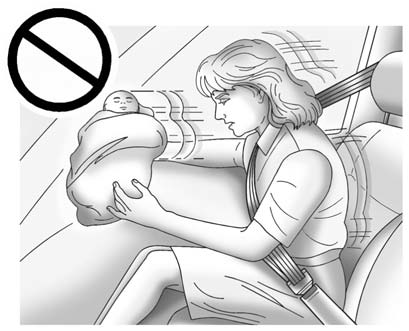
Never hold an infant or a child while riding in a vehicle. Due to crash forces,
an infant or a child will become so heavy it is not possible to hold it during
a crash.
For example, in a crash at only 40 km/h (25 mph), a 5.5 kg (12 lb) infant will
suddenly become a 110 kg (240 lb) force on a person's arms. An infant should be
secured in an appropriate restraint.
WARNING
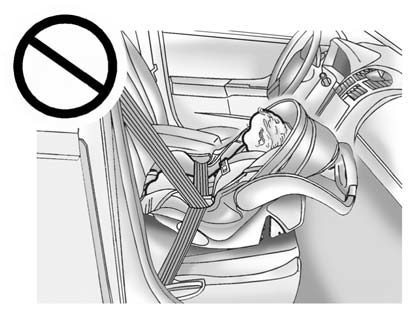
Children who are up against, or very close to, any airbag when it inflates can
be seriously injured or killed. Never put a rear-facing child restraint in the
right front seat. Secure a rear-facing child restraint in a rear seat. It is
also better to secure a forward-facing child restraint in a rear seat.
If you must secure a forward-facing child restraint in the right front seat,
always move the front passenger seat as far back as it will go.
Q: What are the different types of add-on child restraints? A: Add-on child restraints, which are purchased by the vehicle owner, are available in four basic types. Selection of a particular restraint should take into consideration not only the child's weight, height, and age but also whether or not the restraint will be compatible with the motor vehicle in which it will be used.
For most basic types of child restraints, there are many different models available.
When purchasing a child restraint, be sure it is designed to be used in a motor vehicle.
If it is, the restraint will have a label saying that it meets federal motor vehicle safety standards.
The restraint manufacturer's instructions that come with the restraint state the weight and height limitations for a particular child restraint. In addition, there are many kinds of restraints available for children with special needs.
WARNING
To reduce the risk of neck and head injury during a crash, infants need
complete support.
In a crash, if an infant is in a rear-facing child restraint, the crash forces
can be distributed across the strongest part of an infant's body, the back and
shoulders. Infants should always be secured in rear-facing child restraints.
WARNING
A young child's hip bones are still so small that the vehicle's regular safety
belt may not remain low on the hip bones, as it should.
Instead, it may settle up around the child's abdomen. In a crash, the belt
would apply force on a body area that is unprotected by any bony structure.
This alone could cause serious or fatal injuries. To reduce the risk of serious
or fatal injuries during a crash, young children should always be secured in
appropriate child restraints.
See also:
Rear Seats
The vehicle's rear seats have adjustable head restraints in the outboard
seating positions.
The height of the head restraint can be adjusted. Pull the head restraint up
to raise it. Try to mo ...
Vehicle Messages
Messages displayed on the DIC
indicate the status of the vehicle or
some action that may be needed
to correct a condition. Multiple
messages may appear one after
another.
The messages that ...
Grade Braking
The Grade Braking shift modes can be activated by pressing the button on the
end of the shift control lever. While in Range Selection Mode, Grade Braking is
deactivated allowing the driver to sele ...