



Heated and Ventilated Front Seats
WARNING!
If you cannot feel temperature
change or pain to the skin, the
seat heater may cause burns
even at low temperatures.
To reduce the risk of burns,
people with such a condition
should use care when using the
seat heater, especially for long
periods of time. Do not place
anything on the seat that
insulates against heat, such as
a blanket, cushion, cover,
or similar item. This may cause
the seat heater to overheat.
An overheated seat heater may
cause a burn or may damage
the seat.
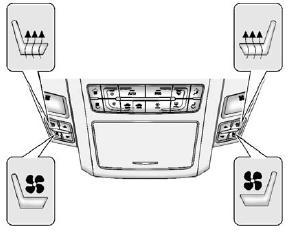
Heated and Ventilated Seat Buttons Shown, Heated Seat Buttons Similar
If available, the buttons are on the climate control panel. To operate, the ignition must be on.
 (Heated Seat): Press to heat
the seat.
(Heated Seat): Press to heat
the seat.
 (Ventilated Seat): If available,
press to ventilate the seat.
(Ventilated Seat): If available,
press to ventilate the seat.
Press the button once for the highest setting. With each press of the button, the seat will change to the next lower setting, and then to the off setting. The lights on the climate control display indicate three for the highest setting and one for the lowest.
The passenger seat may take longer to heat up.
The heated and/or ventilated seats are canceled after the ignition is turned off.
Remote Start Heated Seats
During a remote start, the heated seats may turn on, depending upon the outside temperature. They are canceled when the ignition is turned on. Press the button to use the heated seats after the vehicle is started.
The indicator lights on the climate control display do not turn on during a remote start.
The temperature performance of an unoccupied seat may be reduced.
See Remote Vehicle Start.
See also:
Pairing
A Bluetooth—enabled cell phone must be paired to the Bluetooth system and
then connected to the vehicle before it can be used.
See your cell phone manufacturer's user guide for Bluetooth functions ...
FCC Information
See Radio Frequency Statement for information
regarding Part 15 of the Federal
Communications Commission (FCC)
rules and Industry Canada
Standards RSS-GEN/210/220/310. ...
Radio Frequency
Statement
This vehicle has systems that
operate on a radio frequency that
comply with Part 15 of the Federal
Communications Commission (FCC)
rules and with Industry Canada
Standards RSS–GEN/210/220/31 ...