



Certification Label
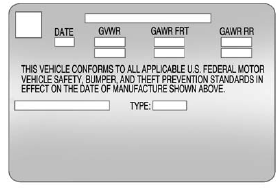
Label Example
A vehicle-specific Certification label is attached to either the driver door edge or the lower center pillar on the driver side of the vehicle. The label tells the gross weight capacity of the vehicle, called the Gross Vehicle Weight Rating (GVWR).
The GVWR includes the weight of the vehicle, all occupants, fuel, and cargo. Never exceed the GVWR for the vehicle, or the Gross Axle Weight Rating (GAWR) for either the front or rear axle.
If the vehicle is carrying a heavy load, it should be spread out.
See “Steps for Determining Correct Load Limit” earlier in this section.
WARNING!
Do not load the vehicle any
heavier than the Gross
Vehicle Weight Rating
(GVWR), or either the
maximum front or rear Gross
Axle Weight Rating (GAWR).
This can cause systems to
break and change the way the
vehicle handles. This could
cause loss of control and a
crash. Overloading can also
shorten the life of the vehicle.
WARNING!
Things inside the vehicle can
strike and injure people in a
sudden stop or turn, or in
a crash.
- Put things in the cargo
area of the vehicle. In the
cargo area, put them as
far forward as possible.
Try to spread the weight
evenly.
- Never stack heavier
things, like suitcases,
inside the vehicle so that
some of them are above
the tops of the seats.
- Do not leave an
unsecured child restraint
in the vehicle.
- Secure loose items in the
vehicle.
- Do not leave a seat folded
down unless needed.
See also:
Instrument Cluster
English Shown, Metric Similar
English V-Series Shown, Metric and Manual Similar ...
Using the Tire Sealant and Compressor Kit to Temporarily Seal and Inflate a
Punctured Tire
Follow the directions closely for correct sealant usage.
When using the tire sealant and compressor kit during cold temperatures,
warm the kit in a heated environment for five minutes.
This ...
Keyless Access Operation
Some vehicles have the keyless access system that lets you lock and unlock
the doors and access the liftgate without removing the remote transmitter from
your pocket, purse, briefcase, etc. The keyl ...