



Turn and Lane-Change Signals
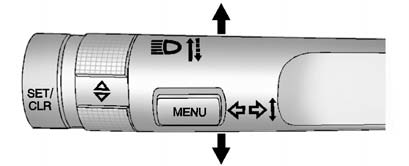
An arrow on the instrument panel cluster will flash in the direction of the turn or lane change.
Move the lever all the way up or down to signal a turn.
Raise or lower the lever until the arrow starts to flash to signal a lane change. The turn signal flashes three times.
The lever returns to its starting position when it is released.
If after signaling a turn or lane change the arrow flashes rapidly or does not come on, a signal bulb may be burned out.
Replace any burned out bulbs.
If the bulb is not burned out, check the fuse. See Fuses and Circuit Breakers for more information.
See also:
Global Positioning System (GPS)
The navigation system determines the position of the vehicle by using satellite
signals, various vehicle signals, and map data.
At times, other interferences such as the satellite condition, road c ...
Power Mirrors
Controls for the outside power
mirrors are on the driver door.
To adjust each mirror:
1. Press (A) or (B) to select the
driver or passenger side mirror.
2. Press the arrows on the control
p ...
Satellite Radio Antenna
The XM Satellite Radio antenna is located on the roof of the vehicle. Keep the
antenna clear of obstructions for clear radio reception.
If the vehicle has a sunroof, the performance of the XM syste ...