



Brake System Warning Light
With the ignition on, the brake system warning light comes on when the parking brake is set. If the vehicle is driven with the parking brake engaged, a chime sounds when the vehicle speed is greater than 5 km/h (3 mph).
The vehicle brake system consists of two hydraulic circuits. If one circuit is not working, the remaining circuit can still work to stop the vehicle. For normal braking performance, both circuits need to be working.
If the warning light comes on and a chime sounds there could be a brake problem. Have the brake system inspected by your dealer.
This light can also come on due to low brake fluid. See Brake Fluid for more information.
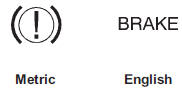
This light comes on briefly when the ignition is turned to ON/RUN. If it does not, have it fixed so it will be ready to warn if there is a problem.
If the light comes on while driving, pull off the road and stop carefully. The pedal could be harder to push or could go closer to the floor. It can take longer to stop. If the light is still on, have the vehicle towed for service. See Towing the Vehicle .
 WARNING
The brake system might not be working properly if the brake system warning light is on. Driving with the brake system warning light on can lead to a crash. If the light is still on after the vehicle has been pulled off the road and carefully stopped, have the vehicle towed for service.
See also:
Braking in Emergencies
ABS allows the driver to steer and brake at the same time. In many emergencies,
steering can help more than even the very best braking. ...
Engine Overheating
The vehicle has several indicators to warn of engine overheating.
There is a coolant temperature gauge on your vehicle's instrument panel. See
Engine Coolant Temperature Gauge .
In addit ...
MP3 Format
There are guidelines that must be met, when creating an MP3 disc. If the guidelines
are not met when recording a CD-R(W), the CD may not play. The guidelines are:
Sampling rate: 16 kHz, 22.05 kH ...