



Rear Safety Belt Comfort Guides
This vehicle may have rear shoulder belt comfort guides. If not, they are available through your dealer.
The guides may provide added safety belt comfort for older children who have outgrown booster seats and for some adults. When installed and properly adjusted, the comfort guide positions the shoulder belt away from the neck and head.
Here is how to install a comfort guide to the safety belt:
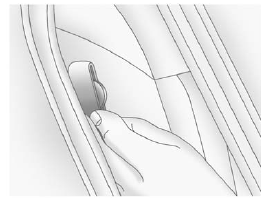
1. Pull the elastic cord out from between the edge of the seatback and the interior body to remove the guide from its storage clip.
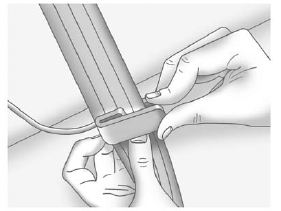
2. Place the guide over the belt and insert the two edges of the belt into the slots of the guide.
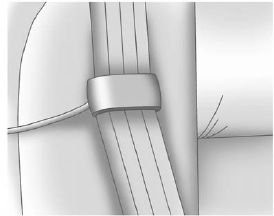
3. Be sure that the belt is not twisted and it lies flat. The elastic cord must be under the belt and the guide on top.
WARNING!
A safety belt that is not properly
worn may not provide the
protection needed in a crash.
The person wearing the belt could
be seriously injured. The shoulder
belt should go over the shoulder
and across the chest. These parts
of the body are best able to take
belt restraining forces.
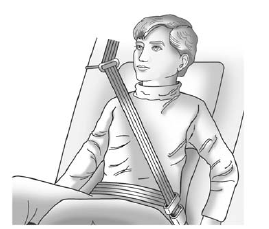
4. Buckle, position, and release the safety belt as described previously in this section.
Make sure the shoulder portion of the belt is on the shoulder and not falling off of it. The belt should be close to, but not contacting, the neck.
To remove and store the comfort guide, squeeze the belt edges together so that the safety belt can be removed from the guide. Pull the guide upward to expose its storage clip, and then slide the guide onto the clip. Turn the guide and clip inward and slide them in between the seatback and the interior body, leaving only the loop of the elastic cord exposed.
See also:
Vehicle Customization
Some vehicle features can be programmed by using the DIC buttons next to the
steering wheel. These features include:
Language
Door Lock and Unlock Settings
RKE Lock and Unlock Feedback
Lig ...
OnStar®
If the vehicle is equipped with an active OnStar system, that system may also
record data in crash or near crash-like situations. The OnStar Terms and Conditions
provides information on data colle ...
Antilock Brake System (ABS)
This vehicle has the Antilock Brake System (ABS), an advanced electronic braking
system that helps prevent a braking skid.
When the engine is started and the vehicle begins to drive away, ABS check ...